

What Is The Political Makeup Of Beattyville Ky
Karen Jennings patted her heavily fabricated upwards confront, put on a sardonic smile and said she thought she looked good after all she'd been through.
"I was an alcoholic start. I got drunkard and barbarous in the creek and broke my back. Then I got hooked on the painkillers," the 59-year-old grandmother said.
Over the years, Jennings' dorsum healed merely her habit to powerful opioids remained. After the prescriptions dried up, she was drawn to the underground drug trade that defines eastern Kentucky today as coal, oil and timber once did.
Jennings spoke with startling frankness about her part in a plague gripping the isolated, fading towns dotting this role of Appalachia. Frontier communities steeped in the myth of self-reliance are now blighted by addiction to opioids – "hillbilly heroin" to those who use them. It'southward a dependency leap upwards with economic despair and financed in part by the aforementioned welfare organisation that is staving off economic collapse across much of eastern Kentucky. Information technology'south a crisis that crosses generations.
One of those communities is Beattyville, recorded by a Us census survey as the poorest white town – 98% of its 1,700 residents are white – in the country. It was as well by one measure – the Census Bureau's American Community Survey 2008-2012 of communities of more than than 1,000 people, the latest statistics available at the time of reporting – among the four lowest income towns in the state. It is the first terminate for a serial of dispatches by the Guardian almost the lives of those trying to do more than survive in places that seem the most remote from the aspirations and possibilities of the American Dream.
Beattyville sits at the northern tip of a belt of the about enduring rural poverty in America. The belt runs from eastern Kentucky through the Mississippi delta to the Texas edge with Mexico, taking in two of the other towns – 1 overwhelmingly African American and the other exclusively Latino – at the bottom of the low income scale. The town at the very bottom of that census list is an outlier far to the west on an Indian reservation in Arizona.
The communities share mutual struggles in grappling with blighted histories and uncertain futures. People in Beattyville are not lonely in wondering if their kind of rural town even has a future. To the young, such places can sometimes experience similar traps in an age when social mobility in the US is diminishing and they face greater obstacles to a good education than other Americans.
At the same time, each of the towns is distinguished by issues not common to the rest. In Beattyville it is the drug epidemic, which has not only destroyed lives but has come up to redefine a town whose fleeting encompass of prosperity a generation ago is still visible in some of its grander official buildings and homes near the centre of the boondocks. Now they seem to accentuate the pass up of a main street littered with ghost shops that oasis't seen concern in years.
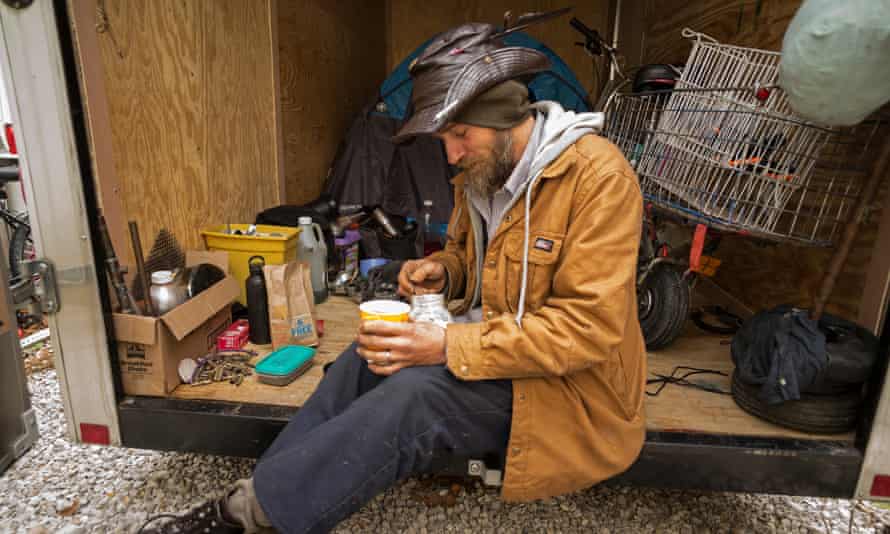
Jennings shook off her addiction afterward xv years. She struggled to find work but eventually got a job serving in a restaurant that pays the $300 a month rent on her trailer home. She collects a small disability allowance from the government and volunteers at a food bank as a kind of atonement. Helping other people is, she said, her fashion of "getting through": "I just want to serve God and do what I can for people here."
It was at the local food bank that Jennings spilled out her story.
"There are lots of ways of getting drugs. The elderly sell their prescriptions to make up money to buy food. There are doctors and pharmacies that just want to make money out of it," she said. "I was the manager of a fast food place. I used to purchase from the customers. People could come in for a hamburger and do a drug transaction with me and no i would e'er notice."
Even as Jennings related the toll of drug abuse – the part information technology played in destroying at least some of her 5 marriages, the overdose that about toll her life and the letter she wrote to her dr. begging for the help that finally wrenched her off the pills – she spoke as if one step removed from the feel.
"You go hooked and you're not yourself. You proceed functioning. You do your job. But I really don't see how I'm alive today," she said.
Information technology was only when Jennings got to the part about her son, Todd, a banking concern vice-president, that she faltered. "I lost my son three years agone from suicide. My lifestyle contributed to his depression. I accept responsibleness for my office of it," she said.
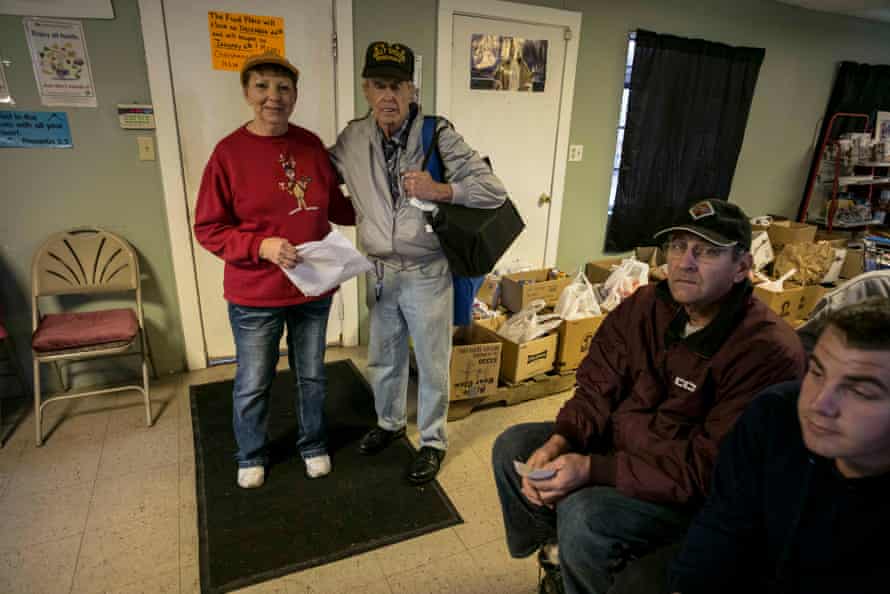
The cluster of people waiting their turn to collect a cardboard box containing tins of beef stew, macaroni and cheese instant dinners, staff of life, eggs and cereal passed no direct comment equally Jennings recounted her history.
Some of them carried their ain sense of defeat at having come to rely on government assistance and individual largesse. But afterwards there was a whiff of suspicion from others who seemed to run into the decades-long turn down of their communities every bit a moral failing.
"I'm not one for helping people who don't help themselves but sometimes you practice the best you tin can and yous all the same demand assistance," said 63-year-sometime Wilma Barrett who, after a lifetime of hard work farming and digging coal, was unsettled to observe herself reliant on welfare payments and the food bank. "A lot of it'southward our own error. The Lord says piece of work and if yous don't work and provide for yourself then at that place'southward no reason why anyone else should. I know it'due south easy to surrender but the Lord tells us not to give up. Too many people here have given upward."
Hidden world
Eastern Kentucky falls within that role of Appalachia that has come to epitomise the white underclass in America always since president Lyndon Johnson saturday down on the porch of a wood cabin in the small town of Inez in 1964 and made information technology the face of his War on Poverty.
The president arrived virtually unannounced at the home of Tom Fletcher, a 38-year-old former coalminer who had not held a full-fourth dimension chore in two years and was struggling to feed 8 children. The visit offered the balance of the U.s.a. a disturbing glimpse into a largely hidden world where houses routinely lacked electricity and indoor plumbing, and children habitually failed to get enough to eat. The 1960 demography records that one in five adults in the region could neither read nor write.
Half a century afterward, while poverty levels accept fallen dramatically in some other parts of the country in good part thanks to Johnson, the economic gap between the region and much of the rest of America is as broad. And its deprivation is one time once more largely invisible to most of the country.
Beattyville'south median household income is just $12,361 (about £8,000) a yr, placing information technology as the third lowest income town in the United states, co-ordinate to that Demography Bureau 2008-12 survey.
Nationally, the median household income was $53,915 in 2012. In real terms, the income of people in Beattyville is lower than it was in 1980.
The town'south poverty rate is 44% to a higher place the national average. Half of its families live below the poverty line. That includes three-quarters of those with children, with the attendant consequences. More than than one-third of teenagers drop out of loftier school or leave without graduating. Just 5% of residents have college degrees.
Surrounding communities are little ameliorate. Beattyville is the capital of Lee Canton, named after the commander of the Confederate regular army of Northern Virginia in the civil state of war, General Robert East Lee.
Five of the 10 poorest counties in the U.s.a. run in a line through eastern Kentucky and they include Lee County. Life expectancy in the county is amongst the worst in the US, which is not unconnected to the fact that more than half the population is obese. Men lived an average of just 68.3 years in 2013, a footling more than eight years brusk of the national boilerplate. Women lived 76.4 years on average, about v years short of national life expectancy.
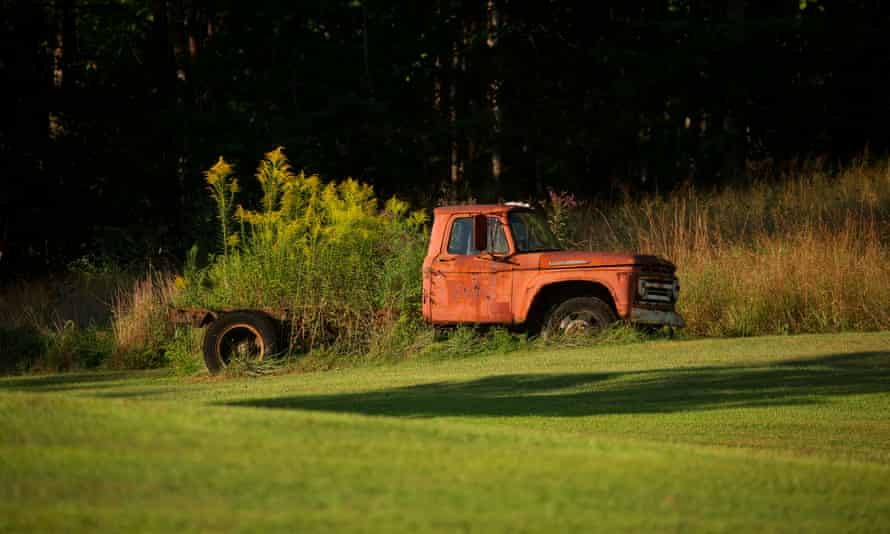
A few months before he visited eastern Kentucky, Johnson said in his Country of the Union address: "Our aim is not just to relieve the symptoms of poverty, only to cure it and, above all, to forestall information technology."
Over time, the focus of that effort shifted to inner-urban center poverty and many of the programmes Johnson launched came to be seen every bit aimed at minorities, even though to this day white people make up the largest number of beneficiaries.
Simply when the president sat on Fletcher's porch in Inez, he had in mind rural poverty of an well-nigh exclusively white region where the coal industry – which for a while provided jobs simply not the much-promised prosperity – was already receding and people struggled for more than than a basic income from the state.
Television pictures of Johnson's visit presented Americans with a hardness of living in the midst of some of the greatest beauty the US has to offer. Life in a log cabin buried in the forest from which it was hewed is romantic until you have to collect water by saucepan in the dead cold of winter.
The War on Poverty did relieve many of the symptoms. Food stamps and housing grants, healthcare for the poor and older people and improved access to a decent education have kept millions from struggling with the deprivations Johnson encountered in Inez. There are few homes in eastern Kentucky without electricity and indoor toilets these days. Simply the promised cure for poverty never materialised.
3 decades after Johnson's visit, Fletcher was yet unemployed only receiving inability benefits. His first wife had died of cancer. His second had been bedevilled of murdering their 3-yr-old daughter and attempting to kill their iv-year-old son with a drug overdose to claim the life insurance.
A motion picture of Johnson's visit describes joblessness in the region as primarily attributable to "lack of industrialisation and losses in the coalmining industry".
People in eastern Kentucky still call it "coal land", even though the decline continued largely unabated and the number of jobs in the industry savage with the passing of each presidency. At that place were 31,000 under Beak Clinton but fewer than 14,000 by the time George W Bush left power.
The number of people employed in mining in eastern Kentucky has fallen by one-half since Barack Obama came to ability, although the long history of decline has been conveniently set aside in the clamour to blame the current president. The more cautious critics say Obama is anti-coal because of his environment policies. Just a no less popular view in the region is that it is part of president Obama's state of war on white people.
Beattyville and Lee County did well out of oil, too, until the 1980s. A decade later, the largest employers in the town were a factory making uniforms, a information company and a private jail property prisoners from Vermont. At present, the garment and computer businesses are gone and Vermont has simply moved its prisoners to Michigan, where it is cheaper to house them.
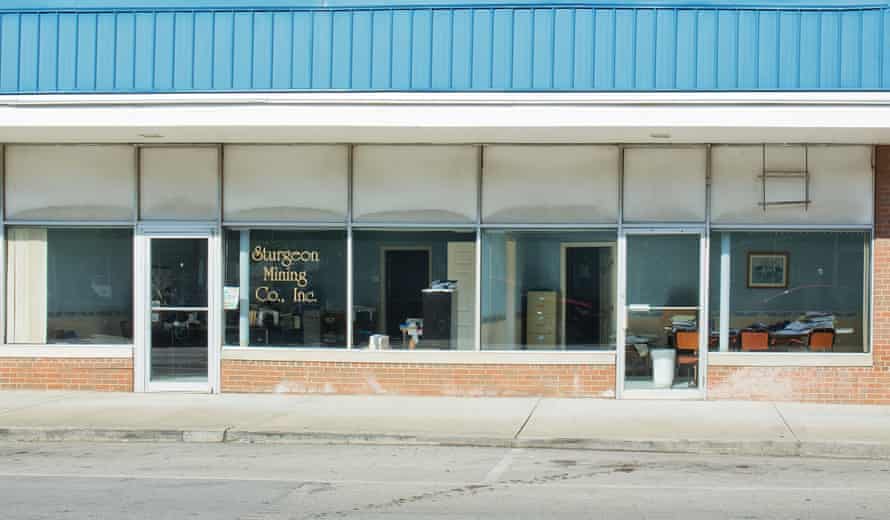
The largest employer in the county is at present the school organization. There are five times as many healthcare workers in eastern Kentucky every bit miners. "Coal country" is today piddling more than a cultural identity.
The part of Ed Courier'southward Sturgeon Mining Company is on the high street. Its few remaining mines involve people digging coal out of hillsides. "I've been in the coal business organization since '78 and the last five years I've been trying to go out of the coal business. In that location's no futurity for information technology here," he said.
Courier's part is an sometime shop front on Beattyville'due south Main street. He nodded towards the window and commented caustically on how many former shops in the once bustling town centre were given over to payday loan companies and charities. 1 gave away what is popularly known as the "Obama Phone", a free mobile available to anyone on nutrient stamps or other assistance that provides 250 minutes of calls per month.
"Things were actually practiced when I came hither in '72 and I ended up staying. When I came hither there were iii new automobile dealerships. In that location hasn't been a new automobile dealership here since '89," he said. "In that location'southward no futurity hither. I have a sense of sadness. I wish people had a better life."
The State of war on Poverty lives on through federal grants. Food stamps, employment programmes and inability allowance take cushioned many people from the harshest effects of the retreat of jobs from the region. Some families nevertheless struggle to put enough food on the tabular array merely their children are fed – if not well in the sense of healthily – at school.
Federal coin likewise congenital Vivian Lunsford a new house – a spacious wooden bungalow with a balcony on two sides and woods to the back, synthetic in a ravine just exterior Beattyville. The narrow road from the town winds by simple log cabins buried in the copse.
"They've probably been there since the early 1900s," she said. "I don't know how people live in them. They're real bones. Their but running water is the stream. Only people simply go along staying there. They don't want to get out. It's the pride. The heritage of that land."
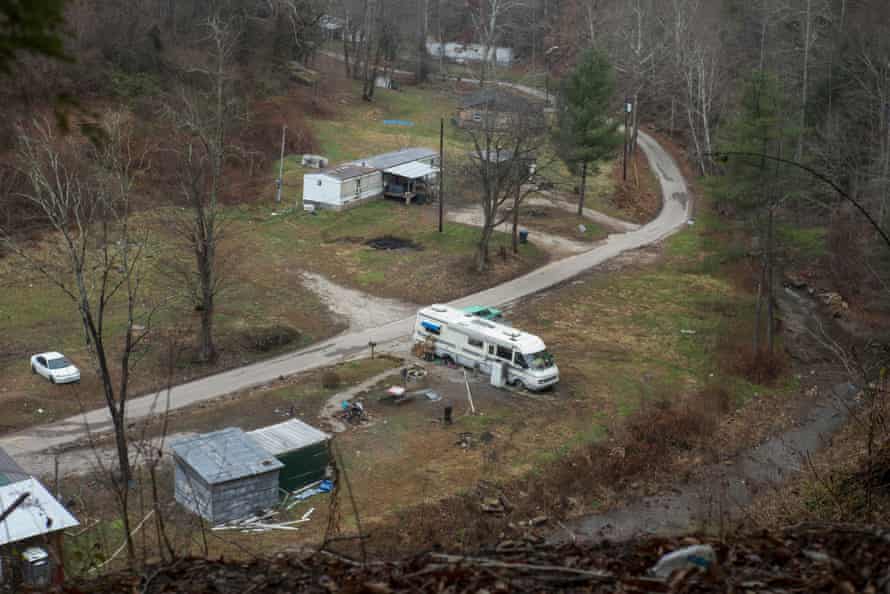
Earlier getting the house Lunsford, 38, was unemployed and homeless. Her mother applied for a grant and a cut-rate mortgage on her daughter'south behalf without telling her, in society to build a more modernistic and spacious version of the one-time wood cabins. Lunsford repays the mortgage at $389 a month, less than it would cost to rent.
"There'south so much grant money went toward information technology that so long as I live there for 10 years I don't have to pay that grant money back," she said.
Lunsford was also able to land a job with the Beattyville housing association that built her home, which she shares these days with her partner and his school-age girl.
"This place is notably poorer. You tin't only get out and get a job in McDonald's. A Walmart is an hour away. I can go to my daddy's in Florida and the world is like a different place. Here is more stuck in time," she said.
"Our homeless situation is really different to a big city. It'south couch surfing. You've got lower income people, grandparents with their children and spouses living there with the grandchildren. They're all crammed into this one firm. In that location'southward a lot of them."
Other people on the waiting list for new homes – wooden bungalows or trailers – are what she calls "fire downs", whose homes were destroyed by fire from candles, kerosene heaters or pot belly stoves. Many of those are in homes disconnected from electricity and other utilities to save money.
"Utility bills are outrageous in a trailer because they lack insulation. I take a little lady I've been helping with, Miss Nelly. She's in her late 70s. Her electric neb in the wintertime here runs virtually $400 a calendar month. She can't beget that. Trailers don't heat good," she said. "Some people choose not to connect to utilities to relieve coin. A lot of people here, their income is like between $500 and $700 a month. That'southward all they get. That'south non a lot, especially if you've got kids and the cost of gas and car insurance and yous've got all these things that have to be paid."
Withal, the rehousing program is non without its issues. Bob Ball congenital Lunsford's home. He also congenital 1 for a human in his early 20s called Duke and his wife, both of whom were unemployed and had been living in a caravan.
Ball has since hired Duke as a worker. Federal money keeps the architect's business concern alive just he still commented with a hint of disapproval at the regime funding homes. "He got a new firm so immature. We all paid for that," said Ball.
Through much of the 19th century, this part of the Bluegrass Land was romanticised in stories of rugged frontiersmen and courageous hunters every bit the image of American cocky-reliance. None more so than Daniel Boone, a hunter and surveyor at the forefront of settling Kentucky. A good part of Lee County carves into a national forest named afterward him.
"Cultural heritage here is important," said Dee Davis, whose family unit was from Lee County, though he grew up in a neighbouring county where he heads the Centre for Rural Strategies. "The first bestselling novels were about this region. It was at one time the iconic America. This kind of frontier: white, noble. This was the iconography."
By the time Johnson arrived a dissimilar image had taken hold – that of the anti-modern, moonshine swilling, gun toting, backwards "hillbilly". The stereotype was perpetuated on television by a popular 1960s comedy show, The Beverly Hillbillies, in which unsophisticated mountain folk find oil on their country, get rich and movement with their guns, bibles and Confederate sympathies to live amidst California's millionaires.
In 2003, Davis led a campaign confronting a CBS plan to remake the one-act as reality television by setting up a poor Appalachian family in a Beverly Hills mansion. One mocking CBS executive remarked on the potential: "Imagine the episode where they accept to interview maids."
Davis beat dorsum CBS only said the planned programme reflected a sense that white people living in poorer communities were blamed for their condition.
"There'south this feeling hither similar people are looking down on you. Feeling like it's OK to laugh at you, to pity you. You're not on the same mutual ground for comparing as someone who's better off or living in a better identify. That doesn't mean it's ever true, it merely means we feel that burden quickly. We're primed to react to people we remember are looking downwards on us. That they judge the states for our apparel, gauge us for our motorcar, gauge united states for our income, the manner nosotros talk," he said.
"This is the poorest congressional district in the United States. I grew up delivering furniture with my dad. No 1 ever said they were in poverty. That's a discussion that's used to judge people. You hear them say, I may exist a poor man but we live a pretty skilful life for poor people. People refer to themselves every bit poor just they won't refer to themselves as in poverty."
Karen Jennings encountered the prejudice when she first left Beattyville.
"When I went to Louisville every bit a teenager to piece of work in Waffle Business firm I had this country accent. They laughed at me and asked if we even had bathrooms where I come up from. People here are judged in the bigger cities and they resent that," she said. "The difference is the cities hide their bug. Here it'southward too modest to hide them. At that place's the drugs, and the poverty. There'southward a lot of the one-time people come in here for nutrient. The welfare isn't enough. Three girls in my granddaughter's class are pregnant. This is a hard place to grow up. People don't hide information technology but they resent being judged for it."
Drug epidemic
The stereotype has evolved. Deepest Appalachia may even so be idea of as astern and clay poor but it's now likewise widely known as in the grip of a prescription drug epidemic. Without prompting, it'due south the first thing Steve Mays, Lee Canton's de facto mayor, talks about.
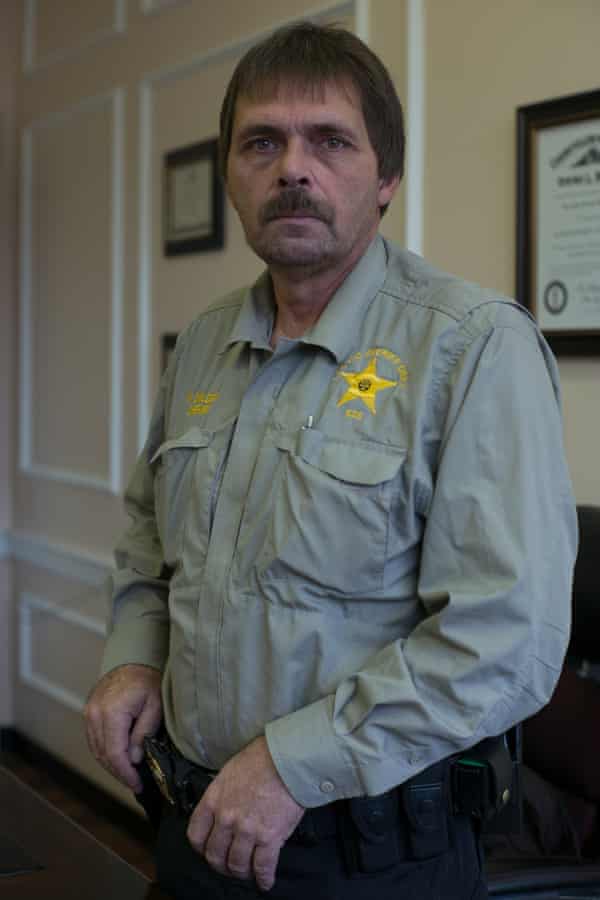
Mays is the county'due south estimate-executive, an antiquated title that carries political but no judicial dominance. His office is in Beattyville, where he was built-in and was a policeman for 16 years, half of them as main of police.
"When I worked as a law officeholder and chief in that location was drugs hither and nosotros made a lot of busts, just things are getting worse," he said. "We don't accept a lot of jobs hither. Some people wait for a way out. They haven't accomplished what they wanted to and they're simply looking for that escape, I gauge. They become that high and in one case it gets a agree of you lot they have a hard time getting away from information technology. They don't think the hereafter looks proficient for them or they don't feel there'southward any promise and so they keep to stay on that drug.
"Information technology'south people of all ages. You lot feel lamentable for them. Expert people. It takes their lives over. They do things you wouldn't ordinarily think they'd do. Stealing, writing bad cheques, younger girls prostitute themselves out for drugs."
Mays feels the sting all the more acutely because his daughter was bedevilled of illegally obtaining drugs from a local chemist's shop where she worked.
In 2013, drug overdoses accounted for 56% of all adventitious deaths in Kentucky and an even higher proportion in the due east of the state.
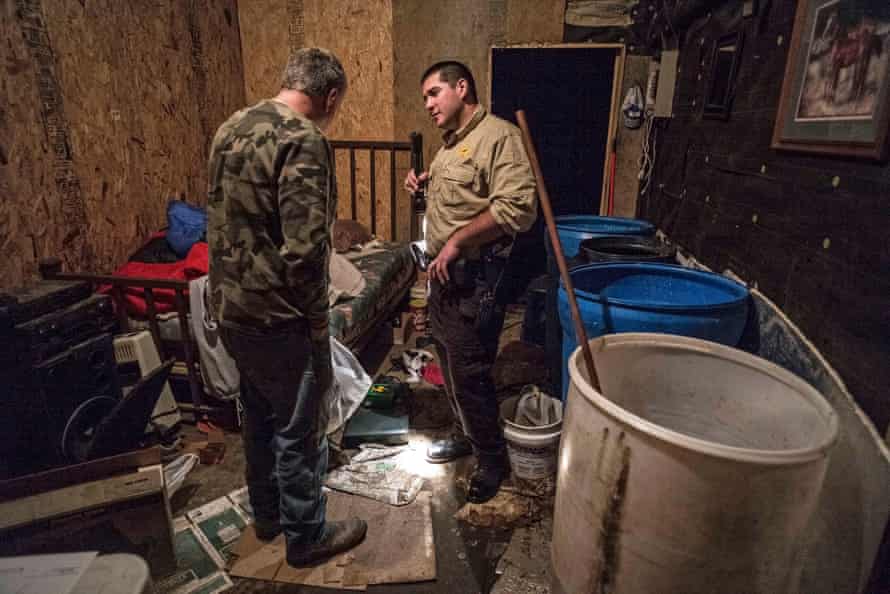
Leading the blight is a powerful and highly addictive opioid painkiller, OxyContin, known locally as "hillbilly heroin". Typically it is ground down and injected or snorted to give an instant and powerful high.
Its misuse is and so routine that the bulk of court cases reported in the local papers are drug related. But near everyone in Beattyville has a story of the human price. Some mention the decline of the town's homecoming queen, Michele Moore, into addiction in the 1990s. Moore struggled by every bit a unmarried mother living in a trailer home before she was stabbed to death by a man while the ii were taking drugs.
At about that time, Beattyville's police chief, Omer Noe, and the Lee Canton sheriff, Johnny Mann, were jailed for taking bribes to protect drug smugglers. Five years later, the side by side Lee County sheriff, Douglas Brandenburg, went to prison for a similar crime.
Amid the relentless devastation of life, at that place is little that shocks. Only 4 years ago residents of Harlan County – a couple of hours' drive to the south-east – were shaken by a series of deaths over six weeks of parents of members of the local boys and girls club. Xi of the children watched a parent die.
Getting the drugs isn't difficult. Elderly people sell their prescription drugs to supplement some of the lowest incomes in the U.s.. The national boilerplate retirement income is nigh $21,500. In Beattyville it is $6,500.
Last year, a chemist's shop owner in nearby Clay County, Terry Tenhet, was jailed for 10 years for illegally distributing hundreds of thousands of pills afterwards police force tied the prescriptions to several overdose deaths. In 2011 alone, he supplied more than than 360,000 OxyContin pills in a county with only 21,000 residents. Those prescriptions were mostly written by doctors in other states.
Prosecutors declared that for years a unmarried hurting clinic nearly i,000 miles away in due south Florida had provided the prescriptions for a quarter of the OxyContin sold in eastern Kentucky. The bus service to Florida is known to police and addicts alike as the "Oxy Limited".
In 2012, Dr Paul Volkman was sentenced to four life terms for writing illegal prescriptions for more than 3m pills from a clinic he ran in Portsmouth, Ohio, on the border with eastern Kentucky. Prosecutors said the prescriptions had contributed to dozens of overdose deaths.
Another doctor, David Procter, is serving 16 years in prison for running a "pill manufactory" at which at least four other doctors were involved in the illegal supply of drugs to eastern Kentucky.
There is little sympathy for doctors or pharmacists acting equally dealers, just there is a view in Beattyville and surrounding towns that people accept been exploited past something bigger than a few medics, largely because they are regarded every bit "backward".
Davis said the drug companies aggressively pushed OxyContin and like drugs in a region where, considering of a mixture of the mining, the rigours of the outdoors and the atmospheric condition, there was a higher demand for painkillers.
"You couldn't go to a medico without seeing a merchant there. Here's this synthetic opium production that's supposed to be expert for palliative intendance – cancer patients – and they start selling it as regular hurting medicine. They knew how highly addictive it was and they sold it anyway," he said. "I live in a town of one,500 people with vii pharmacies as well as pain clinics and methadone clinics and the total fill-in manufacture. Everybody gets paid, doctors and pharmacists and lawyers."
Recently released research shows that corruption of powerful opioid painkillers is in part responsible for a sharp rising in the death rate amid white middle-aged Americans over the by two decades, specially less-educated 45- to 54-twelvemonth-olds. The report past academics at Princeton university also blamed misuse of booze and a rise in cheaper high quality heroin forth with suicides. The researchers said they suspected that financial stress played a part in people taking their lives.
OxyContin'south manufacturer, Purdue Pharma, was penalised $634m by a federal court in 2007 for misrepresenting the drug'southward addictive furnishings to doctors and patients. Purdue is now being sued past the Kentucky regime. The state's chaser full general, Jack Conway, accuses the visitor of concealing information most the dangers of the drug in order to increase profits, and its salespeople of claiming OxyContin is less addictive and safer than it is.
"I want to hold them accountable in eastern Kentucky for what they did," Conway told the Lexington Herald-Leader. "We have lost an entire generation."
Purdue has denied the merits.
Late last year the Beattyville Enterprise reported that pharmacists in the town were appealing to drug companies for greater control over another prescription medicine, Neurontin, which is increasingly in demand and has been found at the scene of overdose deaths. Heroin utilize is also on the rise.
Ask where people get the coin for drugs and just about everyone blames it on welfare in general and the trade in what is known locally as "pop" – soft drinks – in particular.
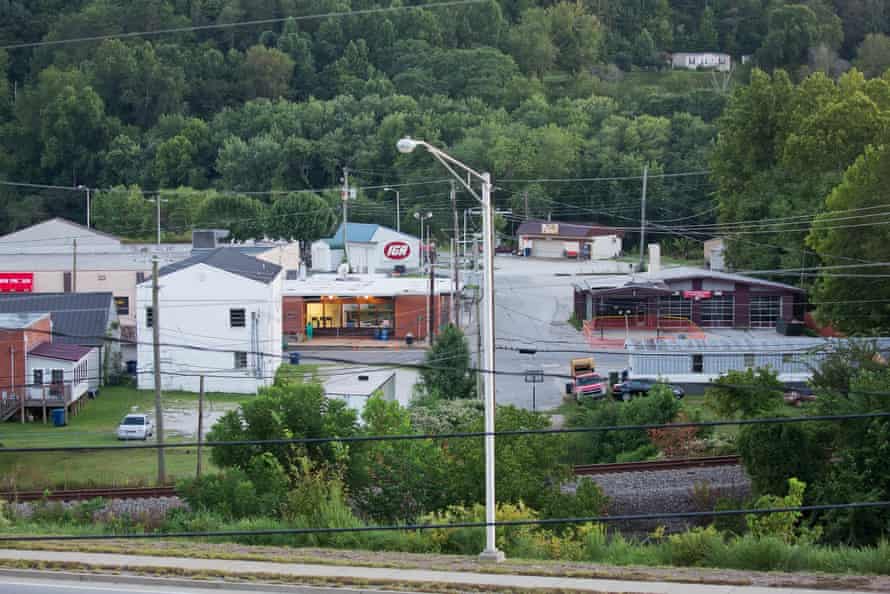
Close to 57% of Beattyville residents merits nutrient stamps. They are paid past electronic transfer on the first of the month. That same day, cases of Pepsi and Coca-Cola are marked downwards sharply in supermarkets and disappear off the shelves, often paid for with nutrient stamps.
They are then sold on to smaller stores at a lower price than they would pay a distributor, in effect turning several hundred dollars of food stamps into cash at nigh l cents on the dollar.
The "pop" scam has become autograph in Beattyville among those who regard welfare as almost as big a blight every bit the drugs themselves.
"We have a lot of dope and the like around hither," said Wilma Barrett at the food bank. "Food stamps get to pay for it. You tin meet it happening and it's sickening. It'southward become a kind of trap for united states out hither."
Courier, the mining company owner, took a similar line, saying welfare had dragged Beattyville down. "It'due south made things worse. It'south disincentivised people from fifty-fifty trying. You can't create a handout and expect people to pull themselves up. You have to give them the incentive to improve. I feel sadness that they're being trapped," he said.
Living on welfare
Apr Newman scoffed at the thought that she was trapped by welfare. She said it had kept her and her children, anile 1 to four years old, from near destitution after she escaped a bad vi-yr relationship.
"Yous definitely do feel resented considering I resented myself. People look downwardly on you for it," she said.
In lodge to get complimentary housing and financial assistance, Newman was obliged to sign on to a Kentucky program providing financial assistance to low-income families with children in combination with grooming or volunteering. She receives a living allowance – not formally a pay check – of well-nigh $800 a month afterwards signing upwards with AmeriCorps, a federally run national service organisation. She besides receives $600 in food stamps. The state covers healthcare costs for the children.
"It's difficult to get by on that simply I have learned. Being on my own and being a single mother, you have to learn to budget. Then if I know that school wearing apparel are coming up, or if Christmas is coming up, iii to four months in accelerate, I get-go to slowly salvage. That manner if things come up up, I have the money for it. I've just learned to save really well," she said.
Newman's federal housing is in a stark cake on the edge of town where she doesn't experience peculiarly safe. "I won't be living hither long though. I'grand actually going to try to do better and move out. You can't raise children in places similar that," she said.
But to move out, she'll demand to pay the hire and the prospects for a total-time job are bleak.
Wilma Barrett does non accept much sympathy for people in Newman's position, even though she too has come up to rely on regime assistance.
"We owned a farm and we dig our own coal out of the hill. I had a center assault and had to quit piece of work four years ago. That'due south when I started coming over [to the food banking company]," she said. "I have a milk cow, chickens for eggs. We didn't need a hog this twelvemonth as we had some meat left in the freezer from last year."
Barrett and her husband pull in almost $one,100 a month in welfare payments and food stamps. Simply she has little fourth dimension for younger people she regards as unwilling to piece of work. "If you're not picky most what you do, there's always something. A job that pays $6 an 60 minutes is better than zero. I was raised on a farm with a couple of mules. I have 3 children and all of them know how to piece of work."
In the late 19th century, Beattyville was trumpeted by the investment visitor developing the boondocks every bit "the gateway to the evolution of all the peachy mineral, lumber and agricultural resources" of eastern Kentucky.

"If a block of wood exist thrown into the waters west of the mountains dividing Kentucky from Virginia it will wind its fashion between towering mountains and rich valleys until it floats over the dam at Beattyville. Eastern Kentucky cannot be adult without Beattyville condign a large and important city," information technology said.
It was not to be. Within a few years, railways had replaced rivers equally the principal means of moving goods and the trains came nowhere near Beattyville. Neither did the highway system that spread across America over the 20th century.
In the end, what eastern Kentucky got was not evolution but plunder.
In his distinguished 1963 business relationship of life in the region, Dark Comes to the Cumberlands: A Biography of a Depressed Area, Harry Caudill described the "greed and cunning of the coal magnates" who left backside few facilities merely enough of misery.
"From the beginning, the coal and timber companies insisted on keeping all, or nearly all, the wealth they produced," wrote Caudill. "They were unwilling to plough more than than a tiny function of the money they earned back into schools, libraries, wellness facilities and other institutions essential to a balanced, pleasant, productive and civilised society. The knowledge and guile of their managers enabled them to corrupt and cozen all too many of the region's elected public officials and to thwart the legitimate aspirations of the people."
Fifty-fifty during the War on Poverty, as billions of dollars were poured into the region, programmes were hijacked to serve politicians and money was diverted by members of Congress to prop up back up in constituencies far from those for which it was intended.
Withal inquire who is responsible for Beattyville's woes today and fingers in the town frequently point at one homo.
"Since Obama it's got bad," said Courier. "There'south the economy but besides a lot of EPA [Ecology Protection Agency] regulations. There's been a lot of changes in the law over the past 2 or iii years with hollow mining. Equally for big-calibration mining here, it's finished. I employed 50 people at the peak. At present information technology'southward six."
The numbers don't back up Courier's claims. The industry has been in decline for decades. Coal production in eastern Kentucky has fallen by 63% since 2000. Mechanisation ate into the number of jobs long before that.
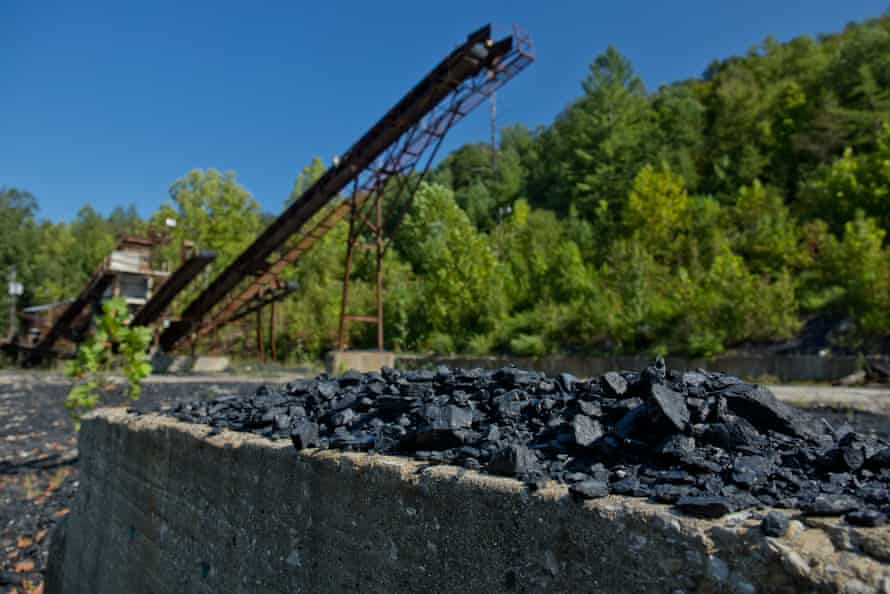
Davis said there had been a political entrada past the mining industry to blame the government for the refuse led by an industry-funded group, The Friends of Coal.
"In the congruent of the pass up of coal jobs and the corresponding refuse in the economic system, the Friends of Coal campaign went from car shows and football games to music events – it was very cultural – and began to deflect pressure on the industry to blaming government policy. They put up posters: Terminate the war on coal," he said.
"Nosotros're in a place right now where a tonne of coal costs about $68 to mine in eastern Kentucky and virtually $12 to mine in Wyoming. They're importing more than Wyoming coal hither than they're using eastward Kentucky coal. But if you ask people why this is, it's Obama. They won't arraign the market, they blame the policy. It's been very user-friendly to shift it to the black guy."
Hostility to the US'southward first black president runs deep. In an editorial, Beattyville's largest circulation newspaper, 3 Forks Tradition, described Obama as "trying to destroy the United States as nosotros know it". Information technology accused him of waging war on "Anglo-Saxon males, who piece of work for a living, believe in God and the right to continue and conduct arms" and called the president and his then attorney general, Eric Holder, "race baiters with blood on their hands".
"He has driven racial wedges betwixt the people that will accept generations to heal," the editorial said without irony.
Vivian Lunsford pushed a folio torn from a pocket-sized notepad across her desk at the housing clan. The writing on information technology was in pencil in capital messages. It was a tribute to Mitch McConnell, the Kentucky senator who is the Republican leader in the Usa Senate. "Mitch volition keep u.s. good," information technology said, calculation he would protect Kentucky from people who were "against coal".
"My stepdaughter wrote that," said Lunsford. "She's besides young to think it for herself. God knows who put that into her head. It wasn't me. Only that'southward how they think effectually hither. She's hears information technology at schoolhouse. She hears it from her friends and their parents. You hear it a lot."
Some other Beattyville resident offered a forthright assessment of Republican support in the town.
"It'due south crazy, it really is. Information technology's not just this county, it's the surrounding counties. There's and so many people on welfare and yet they vote Republican and it's crazy. I'm embarrassed, I actually am. I empathize a lot of it's considering they're afraid what colour is our president, and that's what they proceed," the person said.
A few hours later the resident asked not to be named "because although every discussion I said is truthful it would upset people around hither".
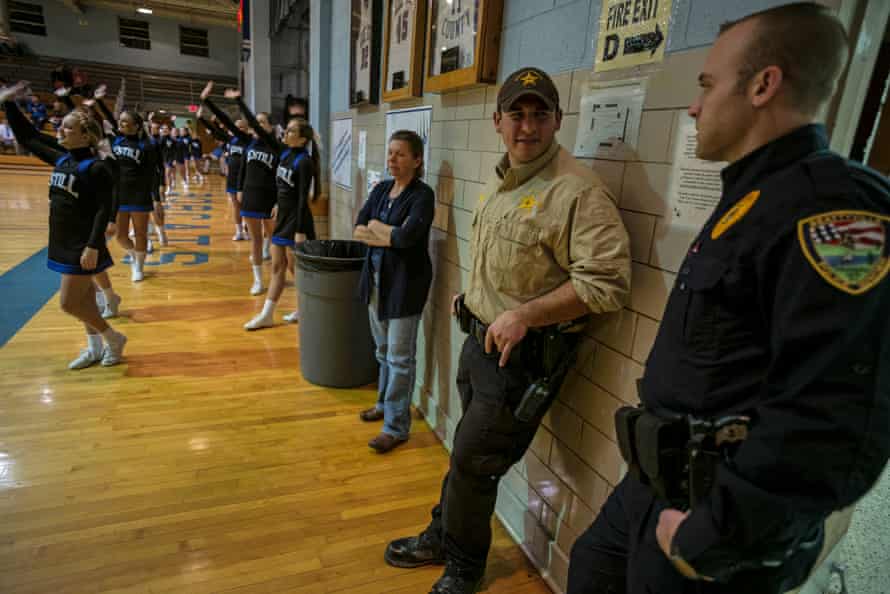
Steve Mays, Lee County'south de facto mayor, is a Republican. He has a picture of McConnell on the shelf behind his desk. "I like Mitch. He'due south very supportive of me when I need grants or something. He always tries to come through for me," said Mays.
But just a few months before, McConnell had claimed "massive numbers" of people were receiving food stamps "who probably shouldn't" and described the programme every bit "making it excessively like shooting fish in a barrel to exist non-productive".
This put Mays in a bind. His party routinely demonises people who receive welfare – only many of his voters rely on it. Mays said he regarded welfare as "a trap", just best-selling that without it the town would die.
"It's catch 22. I don't know what y'all practise. I run into people who really need the help. I meet them in this office every day. They struggle and couldn't make it without it. But I run across some people taking advantage of it also," he said. "I'm not completely confronting welfare. I don't think but everyone should become it, I don't hold with that. There's people that need it but information technology'due south taken advantage of by people that could work. But I'chiliad not 1 of those who says there shouldn't be welfare."
Still, he acknowledged the seeming contradiction of people voting for a party that was so scornful of the government assistance their boondocks survived on.
"You lot're right, Republicans are against that. But that'south non why people effectually hither are registered Republican. It'due south because of local candidates or family history. My dad was Republican. I'chiliad raised a Republican and voting Republican. That's just the style it is," he said.
This is routinely, and sometimes sneeringly, characterised by Democrats in other parts of America as poor white people voting against their own interests. It's a view that exasperates Davis.
"They say, why aren't these people voting their cocky-interest? People always vote their cocky-interest if they can see it. If they believe the regime doesn't piece of work, if they believe that the Democrats don't actually give a shit about people similar them, don't desire to be in the same room with them, they want their vote but don't want to hang out with them, then every bit they encounter information technology they're voting their self-interest," he said.
And so what's the futurity?
"Information technology'south bad. I don't think rural America has a future," said Courier. "The reward rural areas had in the past of cheap labour is gone. Nosotros used to accept a lot of little factories in this area but they've gone to United mexican states or China. In rural areas housing is cheap only everything else costs more. Utility rates are higher. Food and send are higher. Management doesn't want to alive in rural areas. Education is horrible here. This is a third-earth county. My kids grew up here until they were viii or nine, and then they went to school in Louisville [a 145-mile drive away]. I wouldn't send them to school here."
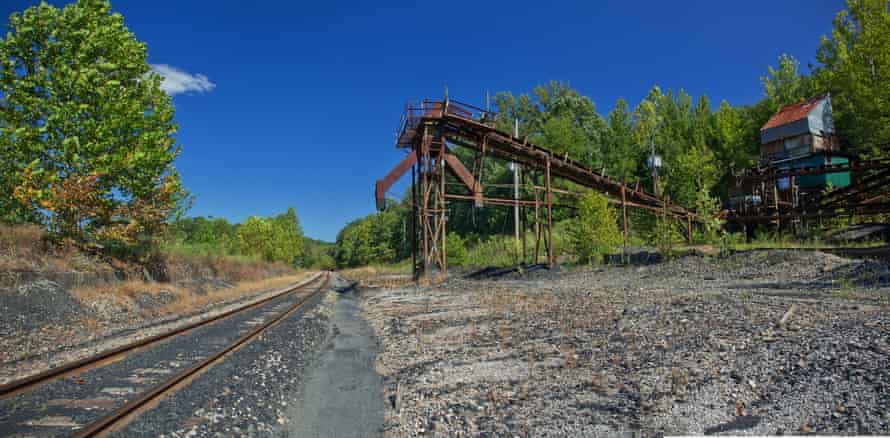
Mays worried that Beattyville and Lee County were losing their best educated while the virtually dependent remained. "These kids come out of high school and graduate with honours, and continue to graduate college. We've got a lot of them. At that place's a lot of smart people hither but at that place's not a lot of opportunity for them here in one case they graduate college. Ordinarily they won't stay here. We need to find a fashion to encourage them to stay," he said.
Just as the railways and highways bypassed Beattyville in the last century, so high-speed internet has failed to penetrate through to the boondocks in more than contempo times. Near people rely on slow and expensive connections through satellite providers. Information technology's a further discouragement to businesses.
Mays said the canton was rooting its hopes for the future in more rustic pastimes. "Nosotros've got rock climbing and four counties here just got together and invested in a recreation park for off-road vehicles. We're trying to become canoes on the river. Nosotros've got a lot of cabins here and a lot of people coming here from all over this country. We're trying to work on that aspect of it because that's what we've got going for us. We just demand a pause," said Mays.
"I feel positive near the time to come. I wouldn't want to alive anywhere else but Lee County. We've got our bug but we've got skilful people … I've seen people with a lot of money that wouldn't requite $ten to assistance somebody out but in this area even people who don't take a lot, when somebody gets down and sick, or if they've got cancer, they ring together and they heighten every bit much money every bit they can for that person to assist them.
"I feel similar the drug problem is our biggest event. Not but does it destroy lives but the economic situation. If a visitor'due south not going to come in because they don't have a lot of workforce to choose from, or don't feel similar they do, there'due south your jobs gone. And then people that move out of here. A lot of people move out of hither to bigger places to detect jobs. So your population starts going downward even more. I don't know how to alter that. I'one thousand not smart enough to say how to do it. But if somehow it could exist reined in, I think we could abound."
So, is the American Dream dead in Beattyville?
"If yous don't experience the American Dream, if you've never been taken out of the box, I don't think you lot believe in it," said Vivian Lunsford: "People have to be able to see or feel it or touch it to believe."
Ed Courier said information technology lived on, but but for those who escaped Beattyville. "There'due south opportunities if you go to college. Merely not for those who stay here. This identify is being left behind," he said.
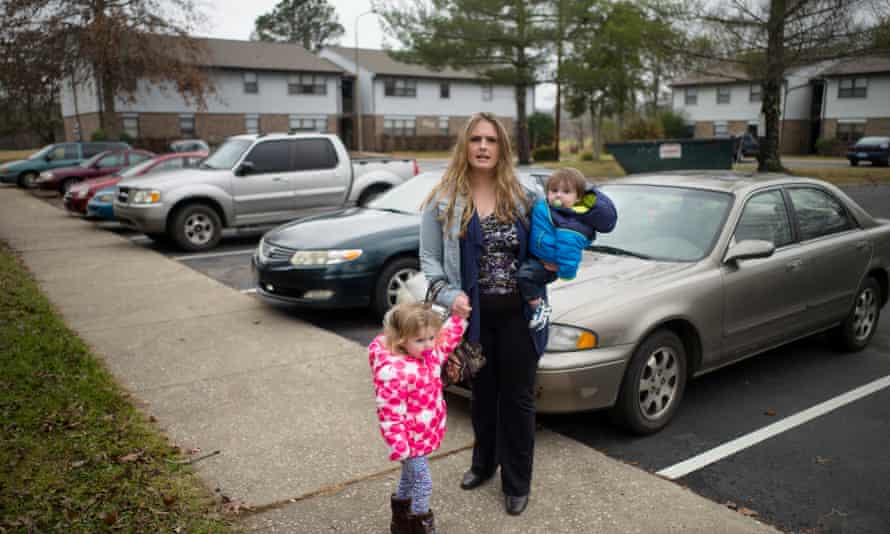
April Newman agreed with that sentiment. She saw her dream being fulfilled far from Beattyville. "I really want to be a instructor and I have to become out of this boondocks to do that," she said. "There's no options here. I don't want to stay here. I don't want my children to stay here. There'south so much that goes on. Information technology'southward just really sad."
Dee Davis said the American Dream lived on even for those who could not escape Beattyville, simply in a unlike way. "It'due south not the dream of the immigrants so much as the dream of being OK, of surviving," he said.
- This article was amended on 13 November 2015 to remove an image that was inconsistent with the Guardian'southward editorial guidelines.
Source: https://www.theguardian.com/us-news/2015/nov/12/beattyville-kentucky-and-americas-poorest-towns
Posted by: bockmartyart49.blogspot.com
0 Response to "What Is The Political Makeup Of Beattyville Ky"
Post a Comment