

When Are Police Allowed To Draw Their Gun

What if Cops Needed Permission to Draw Their Guns?
A twelvemonth has passed since the most notorious police murder of a Black human being this century, and then little has changed. With each week, the public learns that nonetheless some other unarmed Black man has been killed by the police, more ofttimes by gun than by knee. Some will find my characterization also reductive; the circumstances of a police encounter matter, they will say. Merely it is the elementary truth. About i Blackness man in ane,000 will be killed past a police officeholder, and nearly 1 in 5 of those men will be unarmed.
Law chiefs who wish to serve and protect—or, brusk of that, to go on their jobs—must exist open to significant operational changes. Here'south i: Make it harder for officers to access firearms.
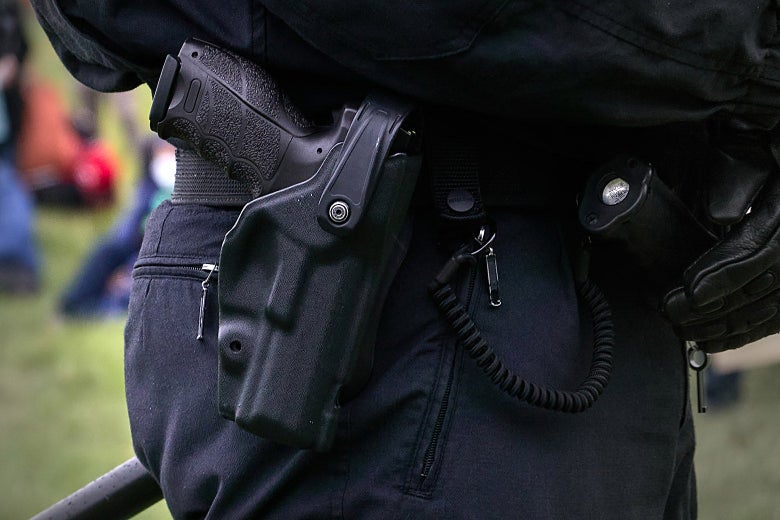
In the field, a loaded handgun is rarely more than inches away from a constabulary officer'southward fingertips. This is truthful even when the officeholder is responding to a cat stuck in a tree, a car that has stalled in an intersection, or a teen with a spray can. Yet most of the tasks that officers perform pose little to no danger to them. While granular data can be hard to come up by, iii police departments, all covering urban areas, take granted public access to statistics breaking down officer activity. These data reveal that officers spend only near four percentage of their time responding to crimes of violence.
On the whole, police work is less dangerous than many other common jobs, such equally farming, garbage drove, or driving a commitment vehicle, where decease is almost two to three times more likely to occur, co-ordinate to information from the Bureau of Labor Statistics. In 2020, garbage collectors experienced 34 deaths per 100,000 workers, delivery drivers 27, farmers 26 deaths, and police officers 14. Perhaps, so, we shouldn't be surprised that more unarmed people, regardless of race, are shot and killed by law officers than constabulary officers are, themselves, shot and killed.
We must face up to the possibility that the well-nigh-constant presence of firearms is doing more harm than adept. Not only to the endless people who have lost loved ones to a law bullet, but also to those who love the officeholder who shot it. Police who are involved in shootings frequently experience trauma and postal service-traumatic stress disorder, and the emotional consequences can be far worse when the shooting is accidental or based upon a error.
At that place are undoubtedly moments that police officers rightfully demand firearms, and the hard question is how to limit access to those moments. Technology provides a means: Guns could be kept in smart lockboxes.
Using this mainstream and relatively cheap device, constabulary dispatchers or qualified police personnel could remotely grant in-the-field officers immediate admission to the contents of a lockbox. Under a new policy, remote admission could be granted only when officers are responding to suspected crimes of violence or other like dangers. For ordinary encounters, like routine traffic stops, the box would remain locked. As a neglect-safe, officers could immediately override locks to respond to unforeseen and dangerous emergencies, merely doing and then would trigger mandatory review by an independent body. Under those circumstances, officers would face sanction if they failed to satisfy the body that the override was justified. Just put, this policy could change the default setting of policing from lethally armed to unarmed.
This is no pocket-sized difference. For one, it volition lower the stakes of police error. Pepper spray and electric shock cause excruciating pain, but the recipient will almost certainly make a complete physical recovery. What'due south more, removing a lethal weapon is likely to change the dynamic of constabulary encounters, making them less stressful and prone to error. Empirical studies have found evidence that only wielding a gun makes one more probable to conclude that another person is holding a gun. And the absence of a police weapon could lower the likelihood that people questioned or detained by police will behave uncooperatively out of fear or anger. Numerous studies take replicated a behavioral miracle known as "the weapons effect": just seeing a weapon increases the likelihood that a person will have aggressive or hostile thoughts. Taking guns out of routine police encounters could also improve public perception. In Not bad Great britain, where unarmed law still outnumber armed police, a recent experiment establish that people were more likely to give negative ratings to images of armed police officers.
Of course, this is the The states, where gun violence is much, much higher than in Corking United kingdom of great britain and northern ireland. But we can look to other American professions to amend our agreement of how access to firearms relates to the dangerousness of a job. Security guards provide the best analogy. Like police officers, security guards engage in crime deterrence and prevention, only different police officers, they commonly practice not carry firearms. Yet, on boilerplate, security guard deaths are much rarer than police officer deaths. Obviously, the 2 jobs are not exactly the aforementioned; law officers respond to crimes in much larger areas and are usually the safety measure of last resort. Only security baby-sit statistics should give us confidence that just introducing friction betwixt police and their firearms will not lead to a meaning ascension in law fatalities.
Even with the inquiry and statistics, critics might still debate that this is another class of gun control, one that will place America's finest at a disadvantage against armed criminals. But this proposal is less virtually control than information technology is about accountability. In-the-field officers would yet be able to access the same weaponry they always take, admitting indirectly in nigh instances. If they seek direct access, they must justify information technology, but but after the fact. Yes, gun governance would be shared, but the collaborator would be a fellow member of the force, ane who is in a better position to make a dispassionate, equanimous decision. And because officers are still proximate to a firearm under this system, the policy is not likely to embolden those who wish them harm. While it is possible that an officer volition be hurt or killed because her gun is still resting in its box, these tragedies will likely exist outnumbered by the peaceful encounters that would otherwise have taken a night turn had a gun been on the officer'southward hip.
In that location might be the objection that the policy relies as well heavily upon people who are unable to witness circumstances of a law encounter firsthand. Putting aside the fact that lockbox overrides allow officers to answer quickly to emergent situations, this criticism doesn't give plenty credit to the role that remote personnel, like 911 dispatchers, already play in police piece of work. Most policing is responsive, and those responses rely primarily on advance descriptions provided by dispatchers; information technology is exceptional when an officer proactively discovers ongoing crime during patrol. The objection likewise lacks foresight. If the demands on remote personnel are higher, specialized preparation and technological help can improve performance. As to the latter, major police departments have already begun to invest significantly in A.I.-powered predictive policing techniques. These Big Data approaches currently suffer from defects, chief amid them is the reification of racial bias. At present, computer scientists accept struggled in their efforts to debias predictive policing tools, and some believe they may never work fairly. Just if they are someday successful, the technology might usefully augment assessments that a offense of violence is occurring. If so, they could lower the adventure that people who are not present at the scene will overlook important correlations or requite too much weight to bear witness that does non yield reliable predictions of danger.
Others might object that the thought of using technology to change essential aspects of policing is too fanciful for real life. But employing remote-controlled lockboxes for police force firearms is not a novel concept. Patents for police devices resembling the i I describe are quondam news, having existed for more a decade. Mainstream companies, like Estes AWS, already market wireless, automated gun lockers for vehicles to police force departments. Outside of policing, smart locks have been normalized; they are the main locking mechanism for millions of homes.
To be sure, the thought of using of this applied science as a prophylactic for misuse of constabulary firearms has by and large been the stuff of science fiction. The dystopian HBO series Watchmen tells the story of a police force officer whose gun is secured by a remote locking mechanism in the dashboard of his vehicle. Despite recognizing that he is in danger, the officer is forced to answer a dispatcher'southward agonizingly deadening series of questions and then that his gun tin can be remotely unlocked. As a result of the delay, the officeholder is unable to defend himself and is shot. While information technology is a tense and effective scene, it ultimately fails to practise the underlying idea justice. Some critics described it as a "dig … at what information technology sees equally liberal overreach" and equally "lazily leaning on a conservative world view" in its reaction to a "sensible" reform. The fictional scene's biggest shortcoming, however, is its failure to bear witness that whatever implementation of remote lockboxes in the real earth would allow immediate manual access without preapproval.
I am not naïve; I expect that this measure will strike many law departments, unions, and officers every bit too farthermost. They should realize, however, that a potentially larger number of readers will say that this measure does not goes far enough. For them, the solution is to take police off the streets, not to modify how they carry. There can be no denying that defunding the police is a mainstream movement; in New York City, abode of the country's largest law strength, more than half of the candidates running for mayor have promised significant cuts to the police budget. Police officers interested in self-preservation should support this measure: If merely because it signals that they are willing to make sacrifices in the involvement of public condom and racial disinterestedness without threatening their job security or changing their job description.
Yes, there will arise the need to refine this policy over the course of its evolution. It is not obvious where the lockboxes should exist placed, who should make up the limerick of the reviewing body, whether override justifications should crave probable cause of imminent danger or a more lenient standard like reasonable suspicion, or how severely that body should punish unjustified overrides. But these particulars cannot serve every bit an excuse to stand still. Departments should launch their own smart lockbox airplane pilot programs so that they can learn what works and what doesn't.
Many police departments have recognized that maintaining the status quo will practice goose egg to stop the disproportionate killing of Black men. They must farther face the possibility that the gun has become a dangerous security blanket, one that, despite its apparent comfort, makes it harder for them to keep the peace. By making firearms a tool of exception, police could make fewer mistakes, crusade less harm, and enhance their legitimacy. Embracing discomfort takes courage, simply should nosotros expect anything less from those who habiliment the badge?
Future Tense is a partnership of Slate, New America, and Arizona State University that examines emerging technologies, public policy, and society.

Source: https://slate.com/technology/2021/05/police-shootings-gun-lock-boxes-cruisers.html
Posted by: bockmartyart49.blogspot.com
0 Response to "When Are Police Allowed To Draw Their Gun"
Post a Comment